

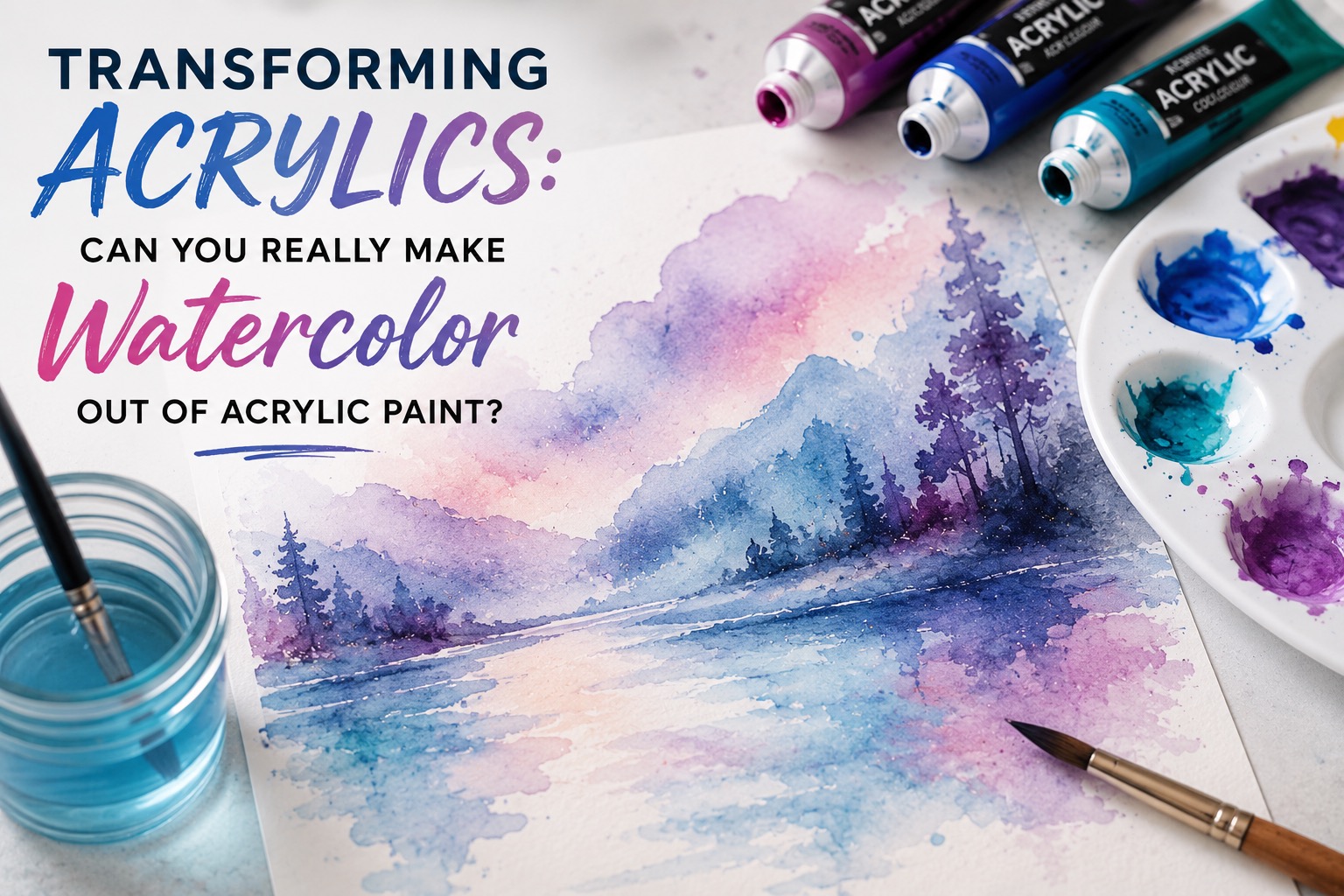
Paint tubes often sit in drawers, unused and forgotten. You might look at your heavy body acrylics and wonder if they can act like delicate watercolors. The short answer is yes, but with a major catch. Many artists ask, “Can you make Acrylic Paint Into Watercolor ?” You can manipulate these paints to look like watercolor, but you must respect the science behind them. Acrylics use a polymer binder, which makes them act quite differently from the gum arabic found in watercolor. This article explains how you can bridge that gap using specific techniques and tools.
Understanding the Chemical Divide Between Acrylic and Watercolor
Acrylic paint and watercolor are cousins in the art world, but their DNA is different. Understanding this chemical split is the first step toward getting the right look.
Acrylics: The Permanent Polymer Binder
Acrylic paint consists of pigment suspended in an acrylic polymer emulsion. When the water in the paint evaporates, the polymer particles fuse together. This creates a tough, plastic-like film. This process is irreversible. Once acrylic paint dries, it bonds to the surface. It is water-resistant and permanent.
This is why acrylics are great for layering but hard to lift. You cannot re-wet an acrylic wash to move the color around. If you put down a color, it stays put. This differs from watercolor, which stays water-soluble indefinitely. If you try to treat acrylics exactly like watercolors, you will quickly find that your paper turns into a mess of streaks and hard lines.
Watercolor’s Unique Transparency and Flow
Watercolor uses gum arabic as a binder. It is a natural substance that keeps the pigment suspended and allows it to sit on top of the paper fibers rather than sinking deep into them. Because watercolor never fully turns into a plastic film, it remains reactive to water. You can lift it, move it, and blend it long after the first application.
The particle dispersion in watercolor also promotes luminosity. Because the pigment particles are not locked in a polymer shell, light can bounce through the layers of paint more easily. This creates that glowing, transparent look that watercolor is famous for. Acrylics lock pigment together, which tends to make the paint film more opaque and less light-reflective.
The Primary Technique: Dilution and the “Washing” Method
You can create a watercolor effect, but you have to change how you handle the paint. It requires a delicate balance of thinning and surface choice.
Achieving Watercolor Consistency with Water Ratio
Many beginners think they can just add endless water to their acrylics to make them look like ink. This is a mistake. Acrylic paint relies on its polymer binder to stay together. If you add more than 30% to 50% water, the binder becomes too thin to hold the pigment.
When the binder breaks down, the paint film becomes weak. You will see a “milky” or chalky look as the pigment separates from the binder. This ruins the transparency you are looking for. Instead of a smooth, glowing wash, you get a patchy, dusty surface. Keep your water additions moderate. If you need more thinning, use a proper medium instead of plain water.
The Critical Role of Surface Preparation
Standard watercolor paper is designed to absorb water and pigment. When you put heavily diluted acrylics on standard paper, the water soaks in too fast. This causes the paper to warp and buckle. The pigment gets trapped in the paper fibers, and you lose the ability to move the paint.
Use canvas paper or primed wood panels for better results. If you want to use paper, it must be properly sized. You can coat your watercolor paper with a very thin layer of matte medium. This creates a barrier. It prevents the paint from soaking in instantly. This gives you more control over the flow and prevents the paper from wrinkling.
Mastering the “Staining” Effect with Acrylic Mediums
If plain water is not enough, you need to rely on specialized products. These tools help you maintain the integrity of the paint while achieving that thin wash.
Using Fluid and High-Flow Acrylics
Standard heavy body acrylics are thick and buttery. They are not meant to be watered down. If you want to paint with washes, buy fluid or high-flow acrylics. These products are already thinner. They contain the same amount of pigment as heavy body paints but come in a consistency closer to ink or watercolor.
These products handle layering and glazing much better than diluted student-grade paints. Because they are designed to be thin, they do not suffer from the same “chalky” breakdown that happens when you over-water heavy body acrylics. They maintain a rich, saturated color even when spread into a thin layer.
Acrylic Flow Mediums: The Game Changer
Professional flow improvers or glazing mediums are essential for this style. They serve a specific purpose: reducing the surface tension of the paint. Plain water makes paint bead up or separate. A flow medium helps the paint spread smoothly across the surface.
To use these, mix a small amount of glazing medium into your paint on the palette. It keeps the pigment suspended while allowing the paint to flow like ink. You can build up layers of transparency that look very similar to watercolor glazes. Unlike water, these mediums strengthen the paint film. This ensures that your wash is permanent and stable once it dries.
Navigating the Limitations: What Acrylic Can’t Replicate
Even with the best techniques, acrylic will never be watercolor. Acknowledging these limits saves you from frustration.
The Challenge of Reactivation and Lifting
The biggest difference is reactivation. In watercolor, you can go back to a dried area, add a drop of water, and lift the color to reveal a highlight. You cannot do this with acrylics. Once the film forms, the color is trapped.
If you make a mistake, you must paint over it. Plan your highlights before you start. Reserve your white space on the paper, or use a small amount of opaque white acrylic paint to add details after the base layers are dry. Work from light to dark, just like in traditional watercolor, because you cannot easily go backward.
Color Blending and Soft Edges
Soft, wet-into-wet blending is a signature move in watercolor. You paint into a wet area, and the colors bloom and move on their own. Acrylics dry much faster. This makes soft transitions difficult.
To get similar results, use a retarder medium. This additive slows down the drying time of the acrylics. It gives you a few extra minutes to blend colors before the paint sets. You can also work on a slightly damp surface to encourage some movement, but practice is required. Precision is key. If you are too slow, the paint will lock, and your soft edge will become a hard, permanent stripe.
Real-World Applications and Successful Transitions
Many professional artists use these techniques to improve their workflow. It is not just about imitating watercolor; it is about using the unique properties of acrylics to your advantage.
Mixed Media Workflows Using Acrylic Washes
Diluted acrylics work perfectly as an underpainting. Many oil painters use an acrylic wash to map out their composition on the canvas. This creates a “stain” that does not move when you apply oil paint over it.
The main benefit here is speed. You can sketch, wash in your values, and let it dry in ten minutes. Then you are ready for your next stage of painting. It creates a permanent map of your composition that will not smear or lift while you work on top of it.
Case Study: Acrylics Mimicking Ink Wash Techniques
Graphic illustrators often use these washes for line and wash work. They create sharp, crisp edges that watercolor sometimes makes difficult. By using flow medium, they can create flat, even fields of color that look like screen-printed ink.
This technique is common in comic book illustration and editorial art. It provides a clean, professional finish. The permanence of the acrylic binder means the finished art is durable and easy to scan or ship without worrying about the colors fading or reacting to moisture.
Conclusion
Can you make watercolor out of acrylic paint? Technically, no. The chemical structure of acrylic is distinct. It creates a plastic film that will never behave exactly like the gum-based pigment of watercolor. However, you can use the right tools to achieve the same look.
By using fluid acrylics, flow mediums, and proper surface preparation, you can create transparent washes and luminous effects. The permanence of the acrylic binder is not a flaw; it is a feature. It allows you to build layers without the risk of lifting or muddying the colors below. If you master these specific techniques, you gain the best of both worlds: the visual style of watercolor with the strength and speed of acrylic.
Looking for high-quality acrylic inks, Watercolor, Brushes, calligraphy supplies, and professional art materials in the UAE? Discover a wide range of trusted artist brands, vibrant colors, and creative tools at Sandhai.ae. Whether you’re an illustrator, painter, designer, or hobby artist, Sandhai offers everything you need to bring your creativity to life — all with fast UAE delivery and convenient online shopping.